Protecting Your Driveway During Dumpster Placement in Norwalk
From boards under the rails to marking your spot in advance, here's what actually protects your driveway when a roll-off dumpster gets delivered in the Norwalk area.
ReadSizing Guides guide
Volume and weight are two separate limits on any roll-off dumpster. Here's how to match a size to your Norwalk-area project without overpaying or running out of room.
Every roll-off dumpster has two ceilings, not one. The first is volume — how much space is inside the box, measured in cubic yards. The second is weight — how many tons the container and the truck hauling it are rated to carry. Most people only think about the first number when they're picking a size, and that's where a lot of Norwalk-area jobs go sideways.
Bulky, light material fills a dumpster up long before it gets heavy. Old couches, mattresses, cabinetry, framing lumber from a deck tear-off, moving-day junk — all of that eats volume fast but weighs relatively little per cubic foot. On a job like that, you'll hit the top of the box well before you're anywhere near the included tonnage. In that scenario, the volume of the container is the real constraint, and it's worth sizing up a step so the crew isn't trying to stack a mattress on top of an already-full load.
Dense material does the opposite. Concrete, brick, tile, roofing shingles, and dirt are heavy in small amounts. A 10-yard dumpster looks like it has plenty of room left when it's a third full of broken concrete, but it can already be at its weight limit. Go over that allowance and you're paying an overage fee per ton on top of the flat rate, which defeats the purpose of booking a flat-rate container in the first place. This is the single most common surprise on renovation and demolition jobs across the whole Fairfield County shoreline area, not just in Norwalk.
The practical rule: for heavy, dense debris, size up in weight capacity more than volume. For bulky, light debris, size up in volume. Harding & Son's flat-rate pricing includes delivery, the rental period, pickup, and disposal up to a stated tonnage allowance for each size, so getting this right on the front end is what keeps the job at one predictable number instead of a surprise invoice. A general sense of Connecticut market pricing for roll-off rentals runs roughly $450 to $900 depending on size and what's going into the box, which is one more reason it pays to match the container to the actual debris rather than guessing.
It's also worth thinking about mixed loads honestly. Most real projects aren't purely one type of debris or the other — a kitchen remodel might send tile and cabinetry into the same container, a roof tear-off might combine shingles with old wood decking. When a load is mixed, whichever limit hits first (weight or volume) determines when the container is effectively full, so it helps to describe the mix of materials when booking rather than just naming the project type.
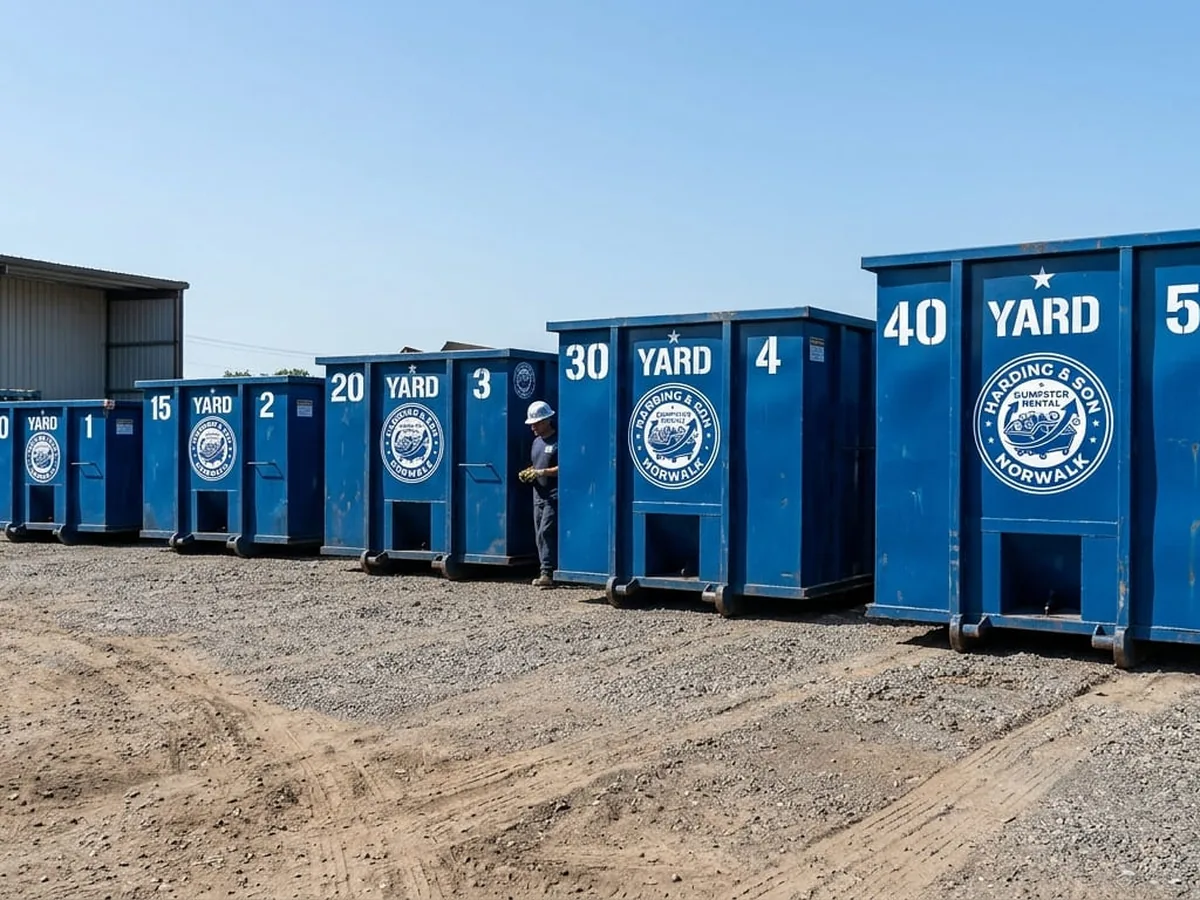
Because the towns Harding & Son serves range from tight lots in South Norwalk to larger inland properties in Ridgefield or Redding, the "right" size for what sounds like the same project can vary. Here's how the five sizes tend to play out in practice.
10-yard. This is the size for a single-room cleanout, a small bathroom demo, a garage or attic purge, or clearing out a modest amount of yard debris after a nor'easter takes down a few limbs. It's also the size that fills up fastest on dense material — a 10-yard loaded with old tile and thinset from one bathroom can already be near its 1–2 ton allowance before the box looks full. It's a good fit for smaller lots too, since its footprint is the most forgiving of the five sizes.
15-yard. A step up that suits a kitchen remodel's cabinetry and flooring, a mid-size basement cleanout, or a roofing job on a smaller Cape or ranch-style home common in East Norwalk or West Norwalk. It handles a mixed load of moderate weight and moderate bulk reasonably well, which makes it the most flexible size for a project that combines a bit of both.
20-yard. The most commonly booked size across the whole service area, and for good reason — it's the middle ground that covers whole-house decluttering, a full roof tear-off on an average single-family home, a multi-room renovation, or a garage-plus-yard cleanout combined into one haul. If you're not sure which size to book, 20-yard is usually the safe default for a single-family home project, since it has enough volume for bulky items and enough weight allowance for a reasonable amount of dense debris mixed in.
30-yard. This is where larger renovation and construction jobs land — an addition, a full-gut renovation of a larger inland home in Wilton or New Canaan, new construction debris, or a large-scale estate cleanout. It's rarely the right call for a small residential job; the footprint alone (22 by 7.5 feet) needs a driveway or lot with real room to spare, which is more common on the larger properties found in towns like Weston, Easton, and Redding.
40-yard. Reserved for the biggest jobs: commercial buildouts, large demolition projects, or a whole-property cleanout with a high volume of bulky, low-density material. Because of its 8-foot wall height, it's a poor fit for hand-loading heavy debris like concrete — that material belongs in a smaller, weight-rated box instead, even on a large job, since trying to fill a 40-yard with dense material will hit the weight ceiling long before the box does anything close to filling up.
One placement note that applies across every size: in denser, older neighborhoods like South Norwalk, driveway and curb space can rule out the larger sizes before weight or volume ever becomes the deciding factor. Farther inland in towns like Weston, Redding, or Trumbull, wider driveways and larger lots usually make the 30 and 40-yard sizes realistic options when the job calls for them. Coastal towns like Westport, Darien, and Fairfield tend to fall somewhere in between, with driveway space varying a lot by neighborhood and by how old the property is.
| Size | Dimensions (L x W x H) | Capacity | Weight Included | Best For |
|---|---|---|---|---|
| 10 yard | ~14 x 7.5 x 3.5 ft | 50–70 trash bags | 1–2 tons | Single-room cleanout, small bathroom demo, garage purge |
| 15 yard | ~16 x 7.5 x 4.5 ft | 80–100 trash bags | 2–3 tons | Kitchen remodel, mid-size basement cleanout, small roof job |
| 20 yard | ~22 x 7.5 x 4.5 ft | 110–130 trash bags | 3–4 tons | Whole-house decluttering, average roof tear-off, multi-room reno |
| 30 yard | ~22 x 7.5 x 6 ft | 170–190 trash bags | 4–5 tons | Additions, full-gut renovations, new construction debris |
| 40 yard | ~22 x 7.5 x 8 ft | 230–250 trash bags | 5–6 tons | Commercial buildouts, large demolition, big cleanouts |
Notice that the 20, 30, and 40-yard containers share the same footprint on the ground — 22 by 7.5 feet — and only get taller as the size increases. That matters for placement planning, because a driveway that can fit a 20-yard box has the ground clearance for a 30 or 40-yard as well; the deciding factor at that point becomes overhead clearance and how much weight the job is actually going to generate, not footprint.
Because there's no online quote form here, every sizing question gets answered by a real person who can ask what's actually going into the container — concrete versus cabinetry versus a mixed pile of both changes the recommendation. That five-minute phone call is often the difference between a flat rate that covers the whole job and an overage charge nobody wanted.
Same-day delivery is realistic for jobs in Norwalk, Westport, and Darien; towns farther inland like Ridgefield, Redding, Bethel, and Monroe are usually next-day. Either way, boards go under the container rails as standard practice at every delivery, protecting the driveway regardless of which size ends up on it.
It also helps to think a step ahead about how the container will be loaded once it's on site. A 10 or 15-yard box sits low enough that heavier items can be lifted in without much effort, while the taller walls on a 30 or 40-yard container mean hand-loading dense material gets harder as the pile grows. If the plan includes a lot of heavy lifting by hand rather than machine loading, a shorter-walled size is often more practical even if it means an extra pickup for a larger volume of lighter debris.
Call Harding & Son at (475) 242-2874, Monday through Saturday, 7:00am to 7:00pm, and describe the project, including roughly what's coming out of the house or site and what it's made of. Getting the size right the first time is the single biggest factor in keeping a roll-off rental simple, and it's a conversation the crew has every day across all fifteen towns in the service area.
Talk to a real person
Call (475) 242-2874 and describe the job. Flat price, stated tonnage allowance, and a delivery window on the same call.
Mon–Sat 7:00am – 7:00pm
From this guide
A single bathroom gut-and-remodel usually fits in a 10-yard dumpster, though if there's a lot of tile and thinset involved, the job can hit the 1-2 ton weight allowance before the box looks full. If two bathrooms are being redone at once, a 15-yard is the safer call.
You can, but it isn't usually the most economical choice. Concrete and other dense material push a container to its weight limit fast, so mixing it with bulky household junk often means paying for a bigger box than the volume alone would require. If you have a substantial amount of concrete, brick, or tile, ask about keeping it as a separate, smaller load.
Each size includes a stated tonnage allowance in its flat rate. Material beyond that allowance is billed as an overage at a per-ton rate. Calling ahead and describing what's going into the container is the best way to pick a size that keeps the whole job under one flat number.
For most garage cleanouts, yes. A 40-yard is built for commercial buildouts, large demolition, or a full-property cleanout with a lot of bulky material. A typical garage, even a fairly full two-car garage, usually fits in a 10 or 15-yard container.
A 30-yard dumpster runs about 22 feet long and needs a clear, level approach roughly 7.5 feet wide plus clearance for the delivery truck to maneuver. In tighter South Norwalk lots this isn't always possible; in that case, a 20-yard or a smaller size placed more efficiently is usually the practical answer. Describe your driveway and the crew can tell you what will actually fit.
Keep reading
From boards under the rails to marking your spot in advance, here's what actually protects your driveway when a roll-off dumpster gets delivered in the Norwalk area.
ReadSouth Norwalk's 19th-century buildings and narrow streets change how debris removal works. Here's what to plan for on a SoNo renovation, from sizing to street permits.
ReadDumpster pricing in the Norwalk area isn't random — size, weight, rental length, and location all factor in. Here's what actually moves the number, and what a flat rate should cover.
Read